What Mind Maps Actually Are (Beyond the Colorful Bubbles)
Mind maps have a reputation problem. Most people picture a facilitator drawing circles on a whiteboard while a team brainstorms product names. That association is real — but it flattens what mind maps actually are.
At their core, mind maps are a radial, node-based structure for representing thought. You start with a central idea — a concept, a question, a topic you are trying to understand. From there, you branch outward with associations, subtopics, and connections, each one linked back to the center or to a neighboring node.
The structure is not decorative. It mirrors how associative memory works: ideas do not live in isolation, they connect to other ideas. A mind map makes those connections visible.
What that looks like in practice
Say you are researching a new market. A linear note might capture: market size, key players, pricing models, risks — one after another down the page. A mind map of the same material might place "market opportunity" at the center, then branch into customer segments, competitive dynamics, regulatory landscape, and open questions — each branch carrying its own sub-branches. You can see the shape of your understanding at a glance, including where the gaps are.
That spatial overview is not just aesthetic. Research into dual-coding theory suggests that engaging both verbal and visual processing helps with comprehension and recall. A mind map forces you to externalize structure, not just content.
The workshop misconception
Workshops borrowed mind maps. They did not invent them. The method has roots in educational psychology and was developed as a tool for personal thinking and learning — not for group icebreakers.
Used well, a mind map is a working document. It evolves as your understanding deepens. Nodes get added, rearranged, connected differently. It is less a snapshot and more a living model of how you currently understand something.
Practical takeaway: If you have only used mind maps in group settings, try building one alone — starting from a question you genuinely have, not a topic you already know. The difference in how it feels is immediate.
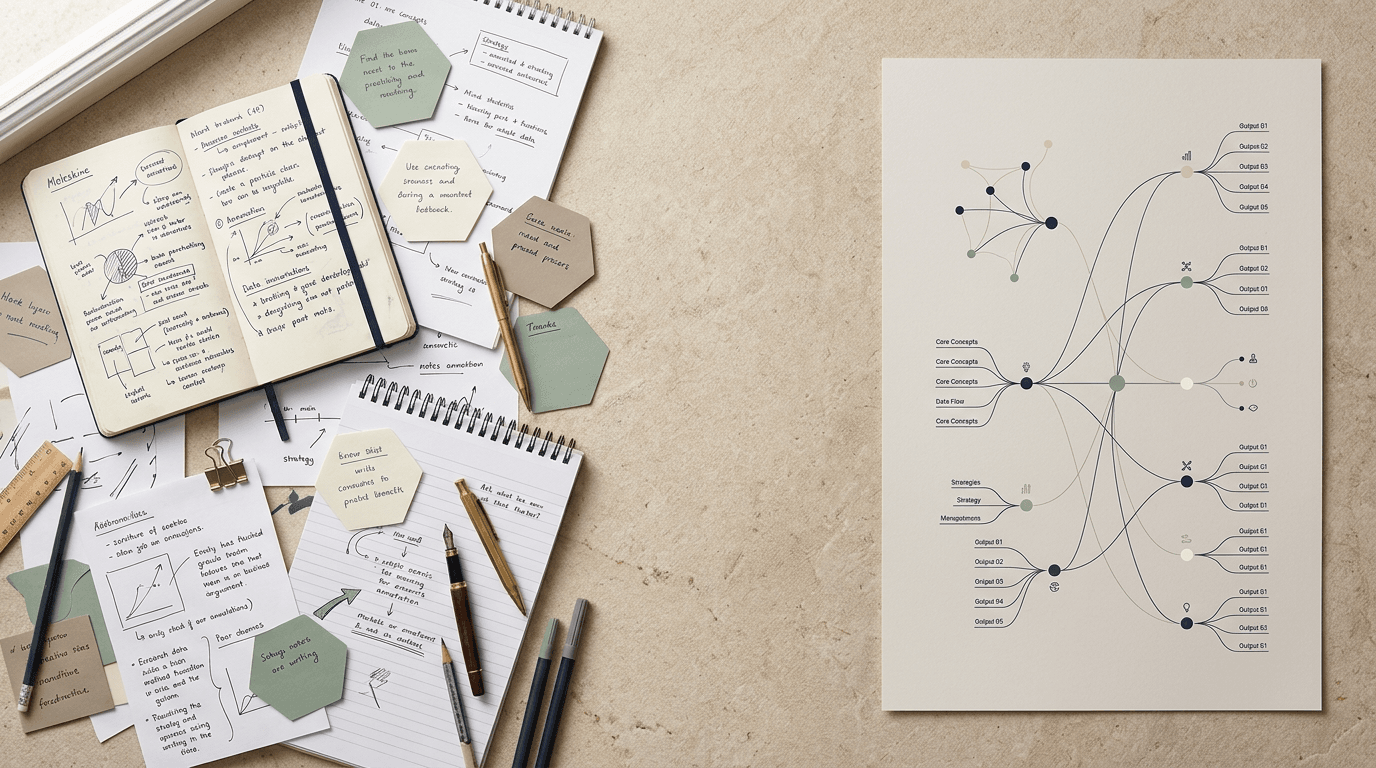
Linear notes remain the clearest format for dense, ordered, or verbatim information.
Mind maps get a fair amount of attention in productivity circles, but honesty matters here: linear notes are genuinely better in several common situations.
Dense factual content is where traditional notes shine. When you need to capture exact definitions, legal language, technical specifications, or verbatim instructions, a structured outline or flowing prose preserves accuracy in ways a spatial diagram cannot. Rearranging nodes does not help when the words themselves are the point.
Sequential processes also favor linear formats. Step-by-step procedures — onboarding flows, recipes, troubleshooting guides, regulatory compliance checklists — depend on order. A numbered list communicates that dependency immediately. A mind map tends to flatten sequence into branches, making it easy to miss that step 3 must happen before step 4.
Reference material built for repeated lookup works better as structured text. If you return to something regularly to scan for a specific detail, a table or outline is faster to navigate than a visual diagram.
Lecture and meeting notes often demand speed. When information arrives faster than you can organize it spatially, a linear format keeps you present. You capture now and organize later — a trade-off that suits text well.
Neither method is universally better. The honest answer is that the format should match the content. Dense, sequential, or verbatim material belongs in structured notes. Exploratory thinking, concept relationships, and brainstorming belong in maps. The most practical skill is knowing which to reach for — and having a knowledge base that handles both without forcing you to maintain two separate systems.
Brainstorming and Ideation: A Clear Win for Visual Thinking
Imagine a product manager kicking off a new feature discovery session. She opens a blank document and starts typing bullet points. Ten minutes in, she has a list — but the list feels flat. Ideas sit in sequence, disconnected from each other. Relationships between user needs, technical constraints, and business goals are invisible.
Now imagine the same session on a mind map. She places the core problem at the center, then branches outward: user pain points in one direction, competitor patterns in another, open questions in a third. As she works, a connection surfaces between a constraint she flagged three months ago and a new user request. That connection would have stayed buried in a linear list.
This is where visual thinking has a measurable edge.
Brainstorming is fundamentally non-linear. Ideas emerge in clusters, not sequences. Mind maps match that structure — they let you place a half-formed thought without forcing it into an order that doesn't exist yet. Traditional notes, by contrast, impose sequence before the thinking is done.
The practical result: mind maps tend to surface more connections during generative work. When you can see everything at once, you notice relationships your working memory would otherwise miss.
The trade-off worth naming: mind maps are tools for exploration, not documentation. Once you've mapped the unknowns and found the connections, linear notes often become the right format for capturing what you decided and why.
The best knowledge workers don't pick one method — they move between them. The friction is in managing two separate tools to do it.